Thursday, March 5, 2015

Mythic Fiction & Contemporary Urban Fantasy

Week 8 “Lady in the Water” and “The Ocean at the End of the Lane”

            Contemporary Urban Fantasy - Going from the mundane world to the fantastical, the two worlds coexisting in the same realm or parallel realms.


Lady in the Water directed by M. Night Shamalan was a bit too corny for me. The main detractor for me was the overly self-indulgent role that Shamalan put himself in as the savior of the story. He plays a role he probably imagines mirroring his own life, a misunderstood author who will one day influence a boy destined to become the president of the United States. His acting in this role is unintentionally funny, with awkward and unbelievable reactions to the turning of events throughout the story. The fairy tale aspects of it are very interesting though, with a mystical woman (a Narf) being prevented from returning from her world by ferocious grass wolves (Scrunts). The music was really great, though.


The Ocean at the End of the Lane by Neil Gaiman begins with the narrator returning to his now dilapidated and run-down childhood home for the first time since he left many years ago. He begins to remember parts of his childhood, when he was seven years old and his family was taking in boarders to help pay the rent. The narrator remembers one of these housemates, a miner, accidentally killing his kitten and later killing himself in his family’s car. This incident releases an ancient evil through a wormhole (a literal hole with a worm which he breaks off half of) in the narrator’s foot in the form of a woman named Ursula. Ursula seduces his family into trusting her, and soon begins a relationship with his father. Lettie Hempstock and the other Hempstocks help his family overcome Ursula’s evil, and have a very close encounter with death. Ursula is eaten by supernatural scavenging birds who also want to eat the narrators heart (because Ursula left a piece of her in him). While speaking with the Hempstocks in present time, the narrator finds out Lettie almost died saving the narrator, by jumping in front of the hunger birds when he tries to sacrifice himself. He finds out this is not the first time he’s returned to the property, and he comes to see Lettie. The narrator’s memory is extremely unreliable, but he asks the Hempstocks to tell Lettie he was there when she returns from Australia (she is actually recovering in another world). This story is very interestingly written, from the perspective of a grown man having flashbacks to when he was a child.

            The myth in this novel is very integrated into the contemporary world. Although it is not as realistic as some myths, it is very inspiring and heartwarming. A myth is defined as a traditional story concerning the early history of a people or an explanation of a natural or social phenomenon, typically involving supernatural aspects. This story definitely fits these criteria. It tells the history of a battle between good and evil and the history of the supernatural Hempstocks. It explains how evil is brought into this world (by suicide) with Ursula’s appearance (and spread with money) and how evil is eradicated with her downfall. This was a very enjoyable book, very interesting and smart and clever. 


Thursday, February 26, 2015

Spiritual Education


Blog Week 7 Harry Potter and the Sorcerer’s Stone (Reread book and rewatched movie)


Growing up while the Harry Potter books were being released was a really special experience. I got to experience my own coming of age adventure while reading Harry’s (in some ways similar) experience. Unlike other series of the genre (Lord of the Rings trilogy and the Hobbit), these books focused on the perspective of kids my age, going through grade school just like me. Without the magical aspects, these novels are really just a relatable tale of three friends growing together through learning, young love, and camaraderie. The magical world of Harry Potter mirrors a lot of issues in the real world. One of the most obvious is the relationship between “Muggles” (Non-magic folk) and the wizard world. One of the main characters Hermione is a “muggle-born” meaning she was born to at least one non-magical parent. Some wizards shun any witch or wizard born to normal parents, reminiscent of the racist and intolerant views some people hold today. Another interesting theme in the book is understanding the right place and time to break the rules. In life, there are always moments when it is appropriate to step out of line, like to help a friend or someone in trouble. Harry breaks many school rules, when someone is in danger, and sometimes just to create a bit of mischief like most children. What seems to be most important is sticking by your friends (Ron and Hermione) and the people who care about you (Hagrid and Dumbledore).


Thursday, February 5, 2015

Witch, Witchy, Witches


From American Horror Story's "Coven" (One of my favorite depiction of witches):


Stereotypes and Gender Ideology of the Witch

The first thing I think of when I hear the word “witch” is scary old ladies. This image of an old, bitter, wart-covered widow is deeply rooted in the common psyche and routinely enforced in modern society. Just watch any of the Disney “Princess” movies. The villain is almost always a hunchbacked old crone. J.K. Rowling challenged the stereotype with her relatable, very normal human witches and wizards, but the popular idea will always endure. This image became prevalent in the 16th and 17th centuries, and it is quite reflective of how society thought about women at the time. Religion posed a catch-22 for women, in expecting then to be both Eve and the Virgin Mary, which of course in turn made society suspicious of those that didn’t fulfill this impossible image (i.e. all women).
Then we see the gypsies and medicine healer women that were present in English communities during the middle ages. They were often older, widowed women that possessed healing and love magic and participated in quasi-pagan practices. Their skills gave them a valuable place in the community, but their stereotypically unattractive demeanor and “magical” practices made them outcasts at the same time. When the Post-Reformation pushed society to rid their communities of suspicious folk, these women were the first to be persecuted.
A type of magic that became associated with these women is known as maleficia, which is when natural, everyday misfortunes happen without a clear explanation. “Bad Luck” happened to be more prevalent in women’s occupations such as cooking and babysitting, so people thought these roles enabled them to practice magic. Food poisoning? Witchcraft. Sick child? Witchcraft. Not sleeping well? WITCHCRAFT! The state-driven witch hunts focused more on demonology accusations, with the belief that midwives’ proximity to unbaptized children led them to steal them for ceremonial sacrifice. High mortality rates of the time “proved” that these women were responsible. These societal roles and jobs that were required of women made them vulnerable to suspicion from the public, indicating that gender ideology directly contributed to the image of the stereotypical witch.

Specialist contemporary writings such as On the Demon-Mania of Witches and the Malleus Maleficarum strengthened the connection between women and witchcraft even further. The Malleus Maleficarum expresses the ideas held by most members of the elite concerning the female state, such as that women were weaker and more impressionable than men, therefore they easily gave into evil spirits and witchcraft. This enforced an image of women as essentially weak with an inherently wicked nature. The writings of Jean Bodin introduces the focus on female sexuality’s role in the demonic stereotype of the witch. He claimed that all witched had a sexual relationship with the Devil, the only evidence of which being that witches are female and the Devil is male. This rose from male concerns about female sexuality, especially the widows’ status as experiences women without a male “master”, thus making them sexually threatening to men. My, how frail the male ego is.  


WEIRD Horror "The New Weird"

Killer Klowns from Outer Space (1988) dir. by Stephen Chiodo


Personal Favorite “Weird Horror” Movie is Tucker & Dale Vs. Evil


Cabin in the Woods (2012) dir. By Drew Goddard (9/10 stars)

Corporate, office setting (Maybe research/scientific based)
Light, casual humor between colleagues
Stereotypical “College Girl” scene (“Smart and quirky” girl virgin+ Ditsy party blonde)
Jocks appear!
Token stoner
Set up characters for typical horror movie trope (Group of friends on vacation to a house in the forest)
At this point, the “weird” part of the horror is the scenes of the mysterious “Research” lab
Sketchy gas stop where the “College Kids” are harassed and creeped out by backwoods man
Long, tedious journey to the dwelling in the trees
Creepy, murderous paintings in the house
One way mirror
The College Kids are being filmed by the scientists! For TV shows??
Using hormones, etc. to control behavior/ subtly influencing actions
More workplace drama, making it seem casual
Mention of “The Ancient Ones”
Employees betting on the characters
College kids partying
Cellar door blows open!
Everyone goes down, it is emphasized by the scientists that this choice is entirely up to the college kids
Dana reads from a diary, the dead rises
Basement is filled with things that will each trigger a different monster, depends on what the participants choose to interact with
“The Buchners” Zombie Redneck Torture Family
There’s Horror Movie Torture filming in Japan too! And most likely other countries!
A couple employees disagree with the practice of murdering groups of people with mystical creatures for entertainment
Curt the Jock and Jules the blonde girl get together
Stoner, Marty, is the smartest one so far, knows something ain’t right
The two fornicating characters (Jules and Curt) are brutally murdered by Z.R.T.Family (Maybe they justify this by them “paying for their sins”?)
Seems they sacrifice people for the “Beast’s eternal slumber”
Definitely some blood letting ritual going on
Gnarly zombies thumping at the front door
“We should split up”
Marty realizes its all a reality TV show, is dragged into the woods and presumably killed
LOTS of violence and gore, Bear traps on a chain is a popular way to catch people
Scene of grade school kids in Japan singing away evil spirit, scientists freak out about “the Ancients rising”
College Kids discover the force field surrounding the property
“The Virgin’s death is optional as long as she suffered”
Surprise Marty is still alive!
Marty and Dana find an elevator with other monsters in it, hundreds of terrifying monsters, like every horror movie within a horror movie.
They let out the nightmares!! And it’s epic.
Jerk Scientist has death by mermaid, super brutal, not a typical mermaid
Marty and Dana find a huge ancient temple, used for ritual sacrifice, to punish young people: “The whore (Jules), the athlete (Curt), the scholar Holden), the fool (Marty), the virgin (Dana)”

Ancient Ones are “Gods that used to rule the world”


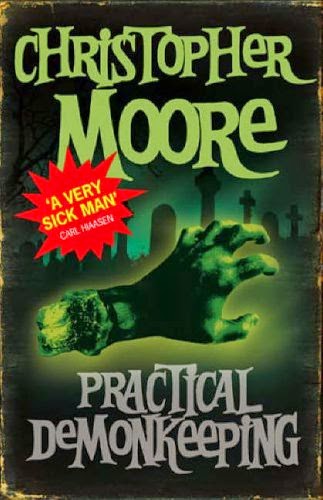
Practical Demonkeeping by Christopher Moore

 “The netherworld is timeless and unchanging, and boring—much like a doctor’s waiting room.”


No one would like to have a homicidal demon named “Catch” as a companion. To make things worse for our protagonist Travis, Catch loves to swallow people whole. If he were to get rid of him, Travis would age about 90 years in a moment. This is his dilemma as he searches for a solution in the fake Californian town of Pine Cove. Joining the merry duo is a foul-tempered djinn (genie) Gian Hen Gian and an elderly man Effrom Elliot, who dreams about women. Somehow Travis is pulled into a pool competition with a hunky hustler, an invisible and uncontrollable Catch (he only becomes visible to others when he feeds), a sarcastic bar owner, and a lovely woman with so many faults she is practically a saint. On top of this bizarre cast of characters, the rules and required circumstances to get rid of Catch are nearly impossible to enact. The horror and fantastical snakes it’s way through a range of absolutely ridiculous yet believably human characters. All the while, Catch complains about having a pacifist like Travis for a master when he would much more prefer an evil dictator with many enemies for him to consume. Moore really captures the little fallacies of the everyday human experience, and the little irrational quirks and faults that make us who we are. His writing really brings this story and the characters to life in this charming, biting, and laugh out loud novel.